"여호와 하나님이 아담이 깊이 잠들게 하시니 잠들매 그가 그 갈빗대 하나를 취하고 살로 대신 채우시고.여호와 하나님이 아담에게서 취하신 그 갈빗대로 여자를 만드시고 그를 아담에게로 이끌어 오시니.아담이 가로되 이는 이는 내 뼈 중의 뼈요 살 중의 살이라 이것을 남자에게서 츼하였즉 여자라 칭하라 하시니.창세기2:21~23" 병원에 있었던 5개월 보름 동안, 그리고 그 이후 수년간, 특히 얼굴 뼈 등을 포함하여 신체 여러 부분을 개조하기 위한 수술을 여러 번 받았다.[3] 이들 수술에서 때로는 이식을 위하여 내 자신의 뼈를 사용했다. 나는 성형외과 의사가 항상 내 흉곽의 오른쪽으로 가서, 수평으로 난 흉터 꼭 그 자리를 통해서만, 수술을 위한 뼈를 취하는 것을 알았다. 어느 날 나는 그에게 ‘왜 뼈가 바닥나지 않는지’를 물었다. 그는 나를 우두커니 바라보더니, 그와 그의 팀은 매번 갈비뼈 전체를 끄집어낸다고 설명했다. “우리는 골막(periosteum)을 손상되지 않은 채로 남겨둡니다. 그러면 보통의 경우 갈비뼈는 다시 그 자리에 자라납니다.” 나는 가정의(家庭醫)의 훈련을 받고 시무도 했지만 새롭게 흥미를 갖게 되었다. 전에는 이것을 전혀 몰랐었다. 골막(이 단어의 문자적 의미는 ‘뼈의 주변’ 이라는 뜻이다)이란 모든 뼈를 감싸는 막이다. 예를 들면, 양고기 다리를 갉아먹을 때 이빨 사이에 무언가 끼는 것이 바로 그것이다. 골막에는 새로운 뼈를 만들어 낼 수 있는 세포가 들어 있다. 특히 젊은 사람에게 있어서, 갈비뼈의 골막은 다른 어떤 뼈보다도 더욱 뼈를 재생시키는 굉장한 능력을 갖고 있다.[4] 흉부외과에서는 갈비뼈를 제거하는 일이 흔하다. 그러면 대개 이들은 전부 혹은 부분적으로 다시 자라난다. 재생되는 양은 갈비뼈를 제거할 때 얼마만큼 조심하느냐에 달려 있다. 그 골막이 가능한 한 손상되지 않은 상태로 남아 있도록 잘 ‘벗겨내야’ 한다. 갈비뼈가 그러한 재생에 대한 이상적인 위치가 되는 주 이유는 거기 붙어있는 늑간(肋間)의 근육이 피의 공급을 잘 되도록 해주기 때문이다. 의사가 처음에 내게 이 이야기를 했을 때, 나에게 즉시 떠오른 생각은 “와, 정말 멋지다. 아담은 결함을 가진 채로 돌아다닌 것이 아니구나!” 이었다. 창세기 2:21절에 하와의 창조에 관하여 이렇게 적혀있다: “여호와 하나님이 아담을 깊이 잠들게 하시니 잠들매 그가 그 갈빗대 하나를 취하고 살로 대신 채우시고” 놀랍게도, 일부 기독교인들은 성인이 되고 나서도, 남자가 여자보다 갈비뼈가 하나 적다고 믿고 있다. 그리고 일부 반창조론자들은, 남자에게는 잃어버린 갈비뼈가 있지 않다는 사실을 사용하여 문자 그대로의 창세기를 비웃고 있다. 내가 사고를 당하기 수년 전에는 이런 질문을 받았을 때 다음과 같은 대답을 하곤 했다 : “만약 당신의 아버지가 원형 톱에의해 손가락을 잃었다면, 그의 모든 자녀들도 역시 손가락이 하나 모자를 것이라고 생각하십니까? 아니면 딸들은 괜찮고 그의 모든 아들들만? 물론 아닙니다. 부모로부터 자녀에게 전달되는 DNA 명령은 글씨와 같은 암호의 형태로 들어있는데, 갈비뼈(혹은 손가락) 하나를 제거한다고 해서 그 암호화된 명령을 변화시키지 않으므로, 모든 자손은 갈비뼈(혹은 손가락)를 전부 갖게 됩니다.” 그런데 위의 모든 내용은 지극히 당연하고 꼭 들어맞지만, 갈비뼈가 다시 자라난다는 정보는 새롭고도 매력적인 차원을 덧붙여 준다. 하나님은 갈비뼈를 골막과 함께 설계하셨다. 그분은 오늘날에 갈비뼈가 다시 자라나듯이, 갈비뼈를 어떻게 제거하면 나중에 다시 자라나는지를 알고 계셨다. 특별한 종류의 기적이 필요하지 않았다.[5] 아담은 그의 흉곽 안에 결함 부분을 한때 가졌을 뿐 영구적으로 가진 것이 아니며, 그의 생애의 수백 년 동안 당신과 내가 오늘날 가지고 있는 것과 같은 수의 갈비뼈를 가지고 있었던 것이다. 각주 아담은 하나님이 만드신 최초의 인간이다. 성경은 그 과정을, 하나님께서 아담을 흙으로 빚어 그 안에 생기를 불어 넣음으로 지으셨다고 기록하고 있다 (창 2:7). 즉, 이 말은 아담은 오늘날의 우리들과는 달리 엄마의 자궁 속에서 수태되어 지은 바 된게 아니라는 이야기이다. 이 사실은 이브에게도 마찬가지여서, 이브 또한, 누구의 뱃속에도 들어 있지 않은 채로 하나님의 지으심을 입어 사람이 되었다. 그렇다면, 아담과 이브는 과연 우리 아이들의 대답대로 배꼽이 있었을까? 오늘날 우리가 잘 아는 대로 아기는 엄마의 자궁 속에 있을 때 필요한 영양분을 탯줄이라는 기관을 통해서 공급 받고 있는데, 아기가 출생하게 되면 이제 이 탯줄은 더 이상 필요가 없게 되므로 출생과 동시에 잘라 버리게 된다. 배꼽은 바로 이 탯줄이 붙어 있던 자리가 흔적으로 남게 된 것이다. 그러므로 오늘날의 모든 사람은 누구나 다 엄마의 자궁 속에서 적당한 기간을 보내고서야 출생을 하게 되므로, 따라서 누구나 예외 없이 그 증거로서 배꼽을 자신의 배 한 가운데에 지니고 다니게 된다. 만약에 누군가가 엄마의 자궁을 통해서 출생하지 않을 수 있었다면, 그는 틀림 없이 다른 사람들과는 달리 배꼽을 지니고 태어나지 않았을 것인데, 바로 하나님이 최초로 만드신 아담과 이브가 유일한 그 예가 될 것이다. 여기 까지 설명을 마치고 이제는 바뀌어진 아이들의 대답을 기대하면서 다시 똑같은 질문을 던졌는데, 뜻 밖에도 이번에는 두 아이의 대답이 다르게 나왔다. 큰 아이는 아직도, 그래도 아담과 이브는 배꼽이 있을 것 같다는 주장이었다. 그 이유인 즉슨, 비록 그들이 엄마의 자궁 속에 존재치 않았었다 하더래도 그 뒤에 나오는 그들의 자손들과 서로 다르게 보이지 않도록 하나님께서 배꼽을 따로 만들어 붙이셨을 것 같다는 생각이었다. 여기서 그만 우리 모두는 서로가 큰 소리로 웃고 말았다. 그래 그거야 진짜 하나님만 아실 일이라고 결론을 내림으로 그 날의 대화는 끝을 내렸는데, 그날 밤에도 필자는 여전히 아담과 이브에게는 우리와 같은 배꼽은 존재치 않았을 것이라는 생각을 바꿀 수가 없었다. 왜냐하면 아담과 이브에게 배꼽이 없다면, 배꼽 없는 그들을 바라 볼 때 마다 그 자손들은 자연스럽게 하나님의 존재를 인정하지 않을 수밖에 없게 되지 않았겠는가? 그것은 우리 인간의 존재의 기원에 대한 무엇 보다도 확고 부동한 창조론적 증거가 아니겠는가? 어느 누가 배꼽 없는 그들을 보면서 감히 인간이 원숭이로부터 진화했다고 말할 수 있으며, 지구의 나이가 수 십억년이나 되었다고 말할 수 있었겠는가? 배꼽 없는 아담과 이브는 당시에 같이 살았던 후손들에게 인간이 하나님에 의해 지은바 되었을 뿐만 아니라, 바로 그들의 나이를 헤아림으로서 지구의 나이를 또한 가르쳐 주는 역할도 할 수 있었을 것이다. 아무리 생각해도 이런 것들을 너무나도 잘 아실 하나님께서 아담과 이브에게 굳이 가짜 배꼽을 만들어 부치셨을 것 같지는 않았다. 아담의 배꼽과 관련지어 이따끔씩 성경을 믿지 않는 사람들이 성경의 내용을 조롱하는 것 중의 하나가, 성경대로라면 남자의 갈비뼈 수가 여자 보다 하나가 모자라야 하는 데 실제로는 그렇지 않음으로 성경이 한갖 꾸며낸 이야기에 지나지 않는 다는 것이다. 실제로 성경(창 2:21-22)에 보면, 하나님께서 아담의 갈비뼈 하나를 취하셔서 이브를 만드셨다고 되어 있으므로, 분명 하나님께서 아담의 갈비뼈 하나를 취하신 것은 사실일 것이다. 그런데, 문제는 갈비뼈 하나를 아담이 상실했다 하더래도 그의 자손은 여전히 완전한 수의 갈비뼈를 갖고 태어나게 되어 있다는 것이다. 생물학적으로는 이와 같은 현상을 가르켜서, '획득형질은 유전되지 않는다'는 말로서 설명하고 있는데, 쉽게 예를 들어 보기로 하자. 가령 우리가 살면서 사고로 눈을 한 쪽 다치거나, 팔을 하나 잃어 버리게 되었다고 하였을 때, 그 뒤로 부터 태어나는 모든 우리의 자손들이 팔이나 눈이 하나인채로 태어 난다면, 우리가 살아 있을 때 새로이 얻게 된 소위 '획득 형질'이 우리의 다음 세대에게로 '유전'된다고 할 수 있을 것이다. 그러나, 우리가 경험적으로 관찰을 통하여 아는 사실은, 아무리 우리가 사고로 팔 다리를 잃게 되었다 하더래도 여전히 우리의 자손은 두 팔과 다리를 갖고 태어 난다는 사실이다. 과거 19세기에 프랑스의 라마르크라는 사람은 이와 비슷한 생각을 가지고, 기린의 목이 긴 이유를 다음과 같이 설명한 적이 있었다. 처음에 기린의 목은 그리 길지 않았었는데, 높은 나뭇가지에 있는 열매를 따먹으려고 자꾸 목을 뻗침으로 목이 길어지게 되었고, 그 뒤 그의 자손들이 그 형질을 물려 받아 그 뒤로는 기린의 목이 모두 길게 되었다는 것이다. 이와 같은 이론을 가리켜 '용불용설'이라고 불렀는데, 그 뒤 유전학적 지식이 늘어남에 따라 사실이 아님이 밝혀지게 되었고, 따라서 획득형질이 유전되지 않는다는 사실은 유전학에 있어서 하나의 법칙이 되었다. 이같은 유전학적 법칙에 비춰 볼 때, 아담이 갈비뼈 하나를 잃은 사실은 그에게만 국한되는 일이요 그의 자손에게는 하등 영향을 주지 않는 일임을 쉽게 알 수 있음으로, 따라서 성경의 이 기록을 가지고 오늘날 남자의 갈비뼈가 여자의 갈비뼈와 그 숫자가 같다는 사실에 대해서 성경의 기록이 마치 잘못된 것인 양 놀리는 것은 전혀 이치에 맞지 않는 이야기가 된다. 여기서 한 걸음 더 나아가 그러면 과연 아담이 하나님께서 갈비뼈 하나를 취하심으로 평생 갈비뼈 하나가 모자라는 채로 그의 생을 살았을 지를 생각해 보기로 하자. 우리 몸을 잘 관찰해 보면, 갈비뼈는 골막이라고 하는 섬유성 조직에 의하여 덮어 있음을 알 수 있는데, 이 골막 조직은 바로 그 안에 뼈를 만들어 내고 또 영양을 공급해 주는 역할을 함으로, 이 조직만 살아 있으면 갈비뼈가 다시 재생되어 생겨 날 수 있게 되어 있다. 그렇기 때문에, 오늘날 병원에서 갈비뼈를 잘라내는 수술을 하더래도 의사들이 이 골막 조직을 다치지 않도록 조심스럽게 잘라내면, 차츰 갈비뼈가 재생되어 수술 후에 곧 상처가 아물고 원래의 모습으로 회복이 되게 된다. 그렇다면, 누구 보다 이 사실을 더 잘 아시는 하나님께서 아담을 잠재우고 갈비뼈를 꺼내는 수술을 하실 때 왜 이 골막 조직을 남겨두고 수술하지 않으셨겠는가? 어쩌면, 아담의 갈비뼈는 얼마 후 멋지게 재생이 되어 하나님의 수술로 인한 아무런 불편도 겪지 않고 지내게 되었을지도 모르겠다. 사람들은 때로는 놀라울 정도로 성경을 믿지 않으려고 한다. 그것은 어쩌면 성경이 누구라도 읽고 이해할 수 있도록 너무나도 쉽게 씌여져 있는 까닭인지도 모르겠다. 어떤 사람들은 성경을 읽으면서도 성경적으로 세상을 이해하는 훈련이 부족하다. 가령 우리는 노아의 홍수로 인해 하나님이 처음 창조하실 때와 바뀌어진 세상에 살고 있는데, 성경을 통해 이같은 사실을 바로 보지 못하면, 창세기의 많은 부분을 이해하지 못하게 된다. 처음에 아담과 이브의 배꼽이 있었다고 생각했던 우리 아이들 처럼, 성경의 기록에 충실하기 보다는 현재 우리가 경험하는 세상의 눈으로 성경을 보면, 성경의 많은 중요한 진리들을 놓치게 된다. 바른 성경의 이해는 우리의 신앙에 중요한 영향을 미친다. 창조과학은 정확한 과학적 근거를 토대로 잘못된 성경의 이해를 바로 잡는데 하나님께서 사용하시는 도구이다. 성경을 정확무오한 하나님의 말씀으로 믿을 뿐만 아니라, 역사적인 그 기록을 토대로 세상을 바라보는 바른 세계관의 정립이 우리 모두에게 절실히 필요하다. - 이브의 배꼽, 아담의 갈비뼈 - 중에서 하나님이 가라사대 우리의 형상을 따라 우리의 모양대로 우리가 사람을 만들고 그로 바다의 고기와 공중의 새와 육축과 온 땅과 땅에 기는 모든 것을 다스리게 하자 하시고 And God said, Language is one critical difference. Humans are "left brained" -- the planum temporale that controls language is much larger on the left. (Laymen may know the term because the left brain also controls right-handedness.) Human infants are born as language learning machines. "First, infants begin forming up categories for the common speech sounds they hear, not whole words so much as the little units we call phonemes, less than a tenth of a second in duration. Categories allow them to generalize across speakers, so that the mother뭩 /ba/ sound and the father뭩 somewhat deeper /ba/ sound are treated the same despite their differences. By about a year of age, babies stop hearing many of these differences, having standardized them.)

아담, 그리고 그의 ‘잃어버린’ 갈비뼈/재생되는 갈비뼈
(Regenerating ribs : Adam and that ‘missing’ rib)
연료를 가득 적재한 탱크차와 고속도로의 제한 최고 속도로[1] 정면충돌한 경험을 다른 사람과 나누고 싶지 않다. 그렇지만, 놀랍게도 나는 거기서 살아났다. 하나님은 분명히 나를 위한 다른 계획을 갖고 계셨다.[1]
1. 1986년 당시 충돌속도의 합은 시속 약 180km(112miles) 이었다.
2. 뿐만 아니라 그 당시 11살이었던 내 딸 리사(Lisa)는 기적적으로 거의 상처를 입지 않았다.
3. 사고의 직접적인 결과로서, 나는 전신마취를 하는 수술을 55번이나 받았다 (대다수의 경우 갈비뼈 제거를 포함하지 않음).
4. 성형외과 의사 David Pennington, 개인 서신, 5월 7일, 1999.
5. 물론, 진짜 특별한 기적은 살과 뼈로부터 하와를 만드신 것이다. 왜 이런 방법을 택하셨을까? 왜 아담처럼 흙이나 혹은 단순한 요소로부터 직접 만들지 않으셨을까? 우리 모두는 ‘아담 안에서’ 죄를 지었다. 그리고 우리는 모두 ‘마지막 아담’이신 예수 그리스도의 희생을 통하여 구속받을 수 있다(고전 15:45). 따라서 하와를 포함하여 우리 모두가 아담의 후손이라는 사실은 중요한 것이다
이브의 배꼽, 아담의 갈비뼈
얼마 전의 일이다. 집에서 가족과 함께 저녁 식사를 마친 후에 이런 저런 대화를 나누다가 화제가 아담과 이브도 우리 처럼 배꼽이 있었는가 하는 쪽으로 넘어 가게 되었다. 은근히 재미도 있을 것 같다는 생각이 들어 당시 초등학교 1, 2학년에 재학 중이던 필자의 두 아이에게 생각을 물어 보니, 둘 다 대답이 같게 나왔다. 아담과 이브도 우리와 똑같은 사람이었으므로 당연히 배꼽이 있었을 것이라는 생각이었다. 성경 창세기에 나오는 아담과 이브를 역사적으로 실제했던 우리와 똑같은 모습을 한 사람이라고 생각해 주는 사실이 고맙고 기특하기도 하다는 생각이 들기도 했지만, 한가지 중요한 사실을 아이들이 놓치고 있음을 발견하고 조금은 아쉬운 느낌도 들었다.
출저: 한국창조과학회And God said,
Let Us make Man ('adam) in Our image,
after Our likeness.
Let Us make man in Our image, after Our likeness:
and let them have dominion over the fish of the sea,
and over the fowl of the air,
and over the cattle,
and over all the earth,
and over every creeping thing that creepeth upon the earth.
(Genesis 1:25-26)
By a year of age, babies are discovering patterns in the strings of phonemes and acquiring six to nine new words every day, just from the examples they hear (long before they begin speaking them). The words acquiring meaning, the phonemes remain meaningless. You can say kids are like 몊ponges? soaking up words but that뭩 too passive a notion, one of the reasons I prefer the more active 멲cquisitive? as the characterization.
So kids have pyramided words atop the phonemes, and now have compound structures made from building blocks. But then they do it again, discovering patterns in the strings of words they hear and inferring the grammar of that particular language: ways of making plurals and past tenses and nested phrases. This happens between the ages of 18 and 36 months. Then they뭨e off detecting patterns on even longer time scales, that of the collection of sentences we call a story. They infer that a satisfying story has a beginning, middle, and a wrap-up ending - and then they start demanding proper endings for their bedtime stories." (from http://faculty.washington.edu/wcalvin/2000/SanDiegoSpeech.htm)
Another great and obvious difference is brain size and function. From our brain comes control of the involuntary and voluntary functions, the sensory perceptions, memory, emotions, consciousness, and intelligence.
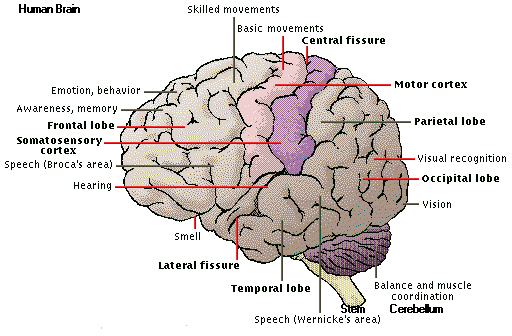
Endocranial Volume (in cm3)
[From Aiello and Dean 1990, Pp. 193]
| Species | Lower 95% Limits for Mean | Upper 95% Limits for Mean |
Mean |
|
Human |
1,159 |
1,243 |
1,201 |
|
Chimpanzee |
391 |
409 |
400 |
|
Gorilla |
452 |
486 |
469 |
|
Orang |
385 |
409 |
397 |
As the primate brain size increases the depth and number of creases and convolutions increase.
|
|
"Among mammals there are two patterns of brain growth. The first pattern is called altriciality. In this pattern the animal is born helpless and extremely immature. The brains of altricial animals are usually half the size of the adult's, and double in size by adulthood. Because of this it takes lots of parental effort to raise the young. Animals following this pattern usually have litters and perform this care for multiple offspring at once. Cats, with their blind and helpless kittens are altricial. The other pattern is precocial. In this pattern the offspring are usually born single and from birth are able to get around quite well. Their brains are nearly adult size at birth. The are alert and all their organs are functioning. An example of this pattern is the horse, the wildebeest etc., where the young will run with the herds within minutes.
Now, according to Walker and Shipman (1996, pp220-222), altricial species almost never have bigger brains than precocial species. The reason is that for all mammals save one, the brain grows rapidly during gestation but then grows less rapidly after birth. There is a kink in the graph of brain size vs. time which occurs at birth. Altricial species whose immature state at birth and subsequent slow down in the rate of growth forever remain behind the more maturely born precocial species.
What humans seem to have accomplished is the trick of keeping the brain growing at the embryonic rate for one year after birth. Effectively, if humans are a fundamentally precocial species, our gestation is (or should be) 21 months. However, no mother could possibly pass a year old baby's head through the birth canal. Thus, human babies are born "early" to avoid the death of the mother. Walker and Shipman (1996, p. 222) write:
"Humans are simply born too early in their development, at the time when their heads will still fit through their mothers' birth canals. As babies' brains grow, during this extrauterine year of fetal life, so do their bodies. About the time of the infant's first birthday, the period of fetal brain growth terminates, coinciding with the beginnings of speech and the mastery of erect posture and bipedal walking."
This pattern of growth has huge implications. Every other primate doubles their brain weight from birth to adulthood. But due to the early birth of humans, we triple our brain's birth rate. Our last 12 month of fetal growth rate of the brain occurs outside the sensorially deprived womb. The vast quantities of sensory input during the first year of life affects the rate and nature of the neural connections. Because of this year of helplessness, parents must provide close physical and emotional support for the infant. Unlike chimp babies who can cling to their mother's fur, human infants cannot even hang on to mother in spite of having the hand reflex. The mother has no fur because she sweats and she sweats because of a big brain which is why she gives birth to her child early. This early birth then requires the mother to care for the infant and increases the bond between mother and child which partially makes us human." (from http://home.entouch.net/ dmd/sweat.htm)
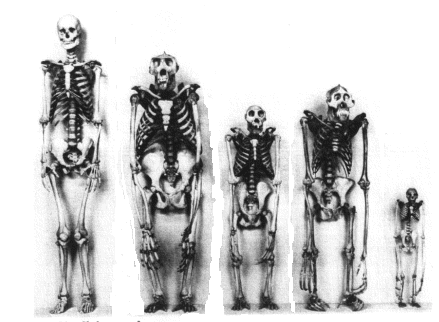
The physical differences are many!
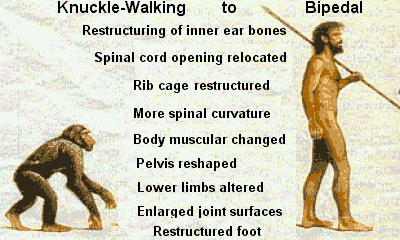
The structural changes to the feet are not simple in that they involve an elaborate plantar aponeurosis, strong plantar ligaments, longitudinal arches, an enlarged musculus flexor accessories, a remolded calcaneocuboid joint, a long tarsus, reorganization of the neuronal innervation and blood vascularization, an adducted (non-opposable) hallux and shortened toes. Many are quick to point out that primates needed to possess opposable digits so they could grasp, and quickly swing from tree branches. But then, how about the feet, did they devolve, humans have the opposable thumb, but not the opposable big toe?
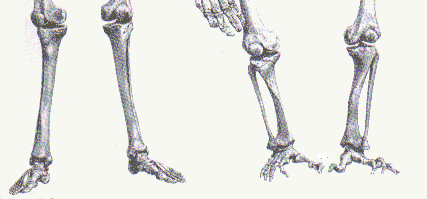
In his 1999 paper published in the Journal of American Podiatric Medical Association, R. Kidd described the evolution of the feet as follows:
"The evolution of the human foot presents an obfuscation: explanations for its occurrence and the exact nature of the mechanisms of change are still not fully understood."
For more details on the differences between humans and the other primates see Appendix A & B.
"Richard Klein, professor of anthropological sciences, in his new book, The Dawn of Human Culture (John Wiley & Sons, April 2002), proposes a plausible theory for the latest stages of human evolution. "It's a nontestable hypothesis," Klein admits. "The book is about human evolution as I understand the record. My genetic explanation for the major behavioral change 50,000 years ago is the most plausible one, but I can't prove it." For Klein this neural mutation hypothesis is the most economical explanation of why anatomy and human behavior drifted apart. Fossilized skulls reveal little about the brain underneath. But a gene mutation may have changed critical neural processes such as speech and language.
The now widely accepted "Out-of-Africa-2" hypothesis is based on the appearance of anatomically and behaviorally modern humans on a small patch in Eastern Africa as recently as 50,000 years ago. All of a sudden these early modern humans developed a new repertoire of hunting skills, novel forms of social interaction and a sense of art. They became creative innovators expanding their mental and technical capabilities. These new achievements drove the early modern humans out of Africa to spread over Europe and Asia. Within a short period of only about 15,000 years they supplanted the Neanderthals in Europe and other nonmodern humans in other parts of the world.
The cause for the drastic change in behavior in the early modern humans is unknown. But the most plausible explanation for the success of modern humans is a sudden biological change.
Klein says. As human brains reached today's size hundreds of thousands of years earlier and skull size didn't change drastically, this mutation would have affected cognitive power rather than overall brain structure. ...
Some of the new (and old) evidence is ambiguous, circumstantial, or even contradictory, but this is inevitable in historical science, which has more in common with a criminal trial than it does with a physics experiment. " (examples, Toumai, Monkey or man?)
(Stanford Report, April 26, 2002, "Anthropologist explores the dawn of human culture in new book" by Christian Heuss and "The Dawn of Human Culture" by Richard G. Klein with Blake Edgar, 2002)
"A fortuitous mutation" , the basis for the entire "theory of evolution", multiplied over and over, from organic slime to the modern human!! "It's a nontestable hypothesis", dosen't this also apply to and describe the entire "theory of evolution"?
It is doubtful that we will ever fully understand the human brain. Some want to say it is no more than a wonderful organic computer, but that seems like a great over simplification. It is a computer that can change and modify its functionality. Tests with people who have had brain surgery and lost some capabilities indicates that over time part or much of the lost functionality can be recovered with non- damaged portions of the brain assuming capability that lost brain sections once controlled. It has "plasticity", it is continually changing. These changes come about by synapses becoming activated or deactivated through the growth or contraction of dendritic spines. And these changes can take place in surprisingly short times. Varying genetic factors combined with varing environmental factors and the "plasticity" of the brain gives us "individuality".
Domination; man was charged to subdue the earth and have dominion over all the life forms that occupy it (Genesis 1:28). Many scientists tell us that the other primates preceded humans by many millions of years, and if this was true, then they had their chance to dominate. And obviously they failed to do so. To our knowledge there is no evidence that either Cro-Magnon man or Neandertal qualified since there is no apparent evidence that they had dominion. Some will argue that presently humans are royally messing it up, and possibly they have a good point. For as one looks around at the state of the human society at this time, one can see many things that seem to be rather undesirable, and which would seem to be detrimental to the ecology.